Aircraft record
Convair F-106 Delta Dart
F-106 · Convair · United States
- Roles
- Interceptor (Primary)
- Era
- Cold War
- Status
- Retired
Reference data
Quick facts
- First flight
- 1956
- Manufacturer
- Convair
- Country
- United States
- Status
- Retired
Reference data
Historical Content
Development and History
Aircraft family
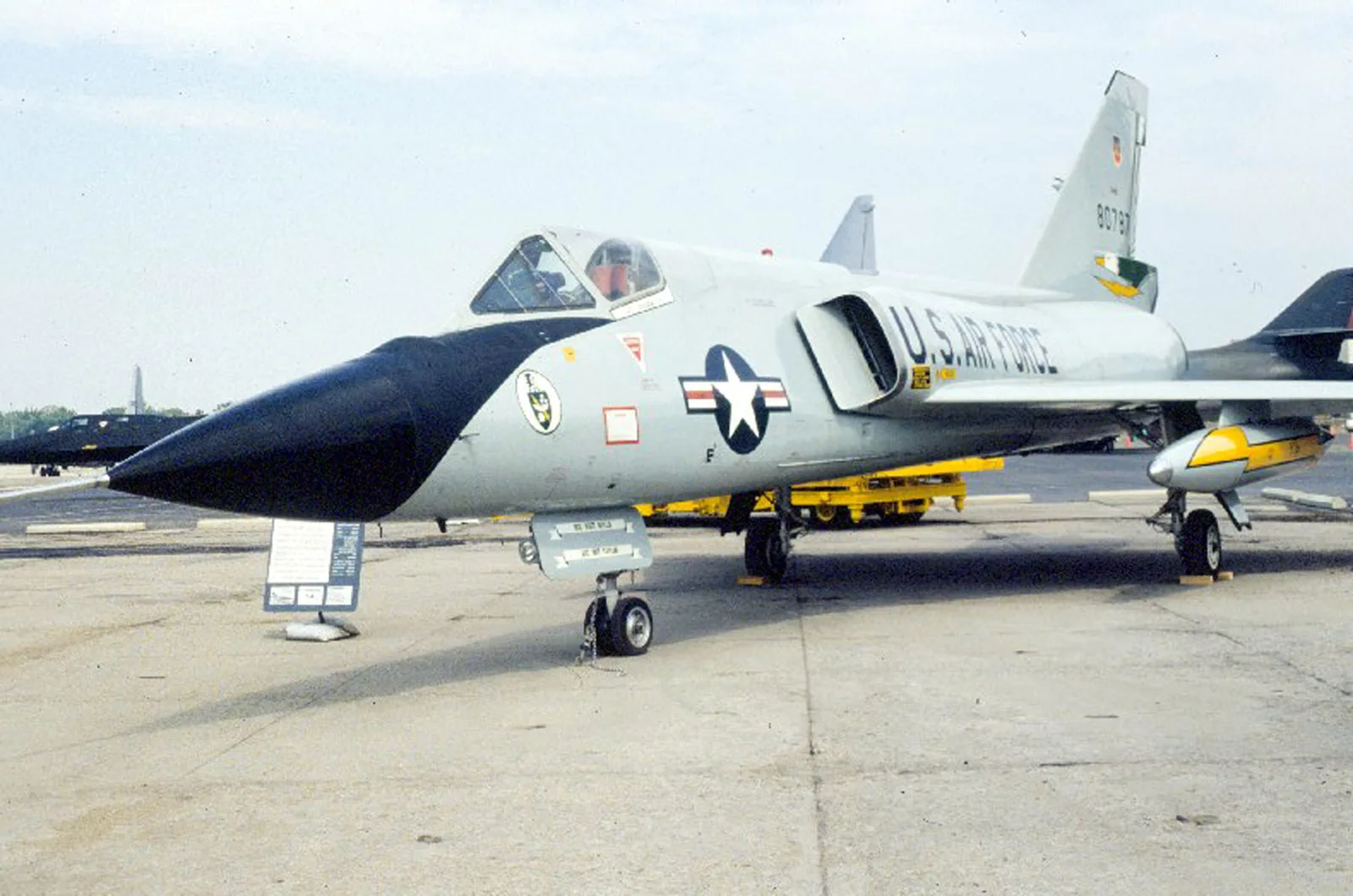
The Convair F-106 Delta Dart was developed from the earlier F-102 Delta Dagger as an all-weather interceptor for the United States Air Force. Initially known as the F-102B, the substantially revised design received a separate designation because of extensive structural changes and a more powerful engine. [1]
Aircraft family
The first F-106A flew on December 26, 1956. Deliveries to the Air Force began in July 1959, and production ended in late 1960. A total of 277 F-106A aircraft and 63 two-seat F-106B aircraft were built. [1]
Design and Interception System
Aircraft family · Based on documented F-106 equipment
An important feature of the F-106 was its Hughes MA-1 electronic guidance and fire-control system. Once airborne, the aircraft could use the MA-1 system to guide it toward the required altitude and interception position. [1]
Aircraft family · Based on documented F-106 equipment
The system could also control the release of Genie and Falcon air-to-air missiles, direct the aircraft away from the target and guide it back toward its base. The pilot resumed control for landing. [1]
Operational Service
Individual aircraft: National Museum of the United States Air Force F-106A · This is an individual aircraft incident, not a general characteristic of the F-106 fleet.
A well-known F-106A preserved by the National Museum of the United States Air Force survived an unusual accident on February 2, 1970. After its pilot ejected during an uncontrollable flat spin, the aircraft recovered and landed without a pilot in a snow-covered field near Big Sandy, Montana. [1]
Individual aircraft: National Museum of the United States Air Force F-106A · This is an individual aircraft incident, not a general characteristic of the F-106 fleet.
Following repairs, the aircraft returned to service before eventually entering the museum collection in 1986. [1]
Reference data
Curated comparison
Reference data
Visual size comparison
Reference data
Specifications
Aircraft specifications
Family-level specifications
Dimensions
| Measurement | Value |
|---|---|
| Length | 21.56 m70 ft 9 in |
| Wingspan | 11.68 m38 ft 4 in |
| Height | 6.2 m20 ft 4 in |
Weight
| Measurement | Value |
|---|---|
| Empty weight | 11,276.8 kg24,861 lb |
| Maximum takeoff weight | 18,974.2 kg41,831 lb |
Performance
| Measurement | Value |
|---|---|
| Maximum speed | 2,454 km/h1,525 mph |
| Cruise speed | 1,046 km/h650 mph |
| Range | 2,414 km1,500 mi |
| Combat radius | 1,183 km735 mi |
| Ceiling | 16,154.4 m53,000 ft |
Powerplant
turbojet
Pratt & Whitney J75-P-17
Quantity: 1
Reference data
Variants
Recorded variants of this aircraft family. Variant entries here do not create separate public pages.
Reference data
Sources
- Convair F-106A Delta DartNational Museum of the United States Air ForceFamily-level specifications · Development and History · Aircraft family · Design and Interception System · Aircraft family · Based on documented F-106 equipment · Operational Service · Individual aircraft: National Museum of the United States Air Force F-106A · This is an individual aircraft incident, not a general characteristic of the F-106 fleet.
- Convair F-106A “Delta Dart”Aerospace Museum of CaliforniaFamily-level specifications