Aircraft record
Supermarine Spitfire
Spitfire · Supermarine · United Kingdom
- Roles
- Fighter (Primary)
- Era
- World War II
Reference data
Quick facts
- Manufacturer
- Supermarine
- Country
- United Kingdom
Reference data
Historical Content
Overview
Aircraft family
The Supermarine Spitfire was a British single-seat fighter that became one of the most recognizable aircraft of World War II. Closely associated with the Royal Air Force, it served in home defense, air combat and later offensive operations across several wartime theaters. [1]
Aircraft family
The Spitfire underwent continuous development during the war. Changes in engines, wings, weapons and equipment produced variants with substantially different operating characteristics. The technical figures on this page refer specifically to the Spitfire Mk Vc, rather than to every aircraft in the Spitfire family. [1]
Development of the Mk V
Variant: Spitfire Mk V series · Subfamily history.
After the Battle of Britain, the Royal Air Force intended to introduce the improved Spitfire Mk III. However, development and production considerations delayed that transition. [1]
Variant: Spitfire Mk V series · Subfamily history.
The emergence of improved opposing fighters, including the Messerschmitt Bf 109F, increased the need for better high-altitude performance. British manufacturers responded with an interim solution based on the Spitfire Mk II airframe and a new Merlin 45 engine. [1]
Variant: Spitfire Mk V series · Subfamily history.
The resulting Mk V entered service during 1941 and became an important intermediate step in the evolution of the Spitfire. [1]
Mk Vc Design and Armament
Variant: Spitfire Mk Vc
The Mk Vc introduced a universal wing intended to support several possible armament combinations. Although many aircraft retained an arrangement of two 20 mm cannon and four machine guns, the revised wing could accommodate other configurations. [1]
Variant: Spitfire Mk Vc
Compared with earlier Mk V wings, the universal wing also incorporated changes to the landing gear. The Mk Vc was therefore more than a simple engine update; it was part of the continuing effort to improve the Spitfire’s operational versatility. [1]
Variant: Spitfire Mk Vc
The museum documents different wingspans for standard and low-altitude shortened-wing configurations. These measurements must not be combined into one unspecified aircraft. [1]
World War II Service
Variant: Spitfire Mk V series · Subfamily history.
Spitfire Mk V fighters operated in multiple theaters during World War II and equipped numerous Royal Air Force squadrons. They were also flown by several Allied air forces, including units of the United States Army Air Forces. [1]
Variant: Spitfire Mk V series · Subfamily history.
As operations shifted from home defense to offensive missions, the Spitfire’s limited range became an important consideration. External fuel tanks helped extend the aircraft’s operating reach, while some later Mk V aircraft received modifications suited to low-altitude missions. [1]
Variant: Spitfire Mk V series · Subfamily history.
Mk V fighters served in North Africa and other theaters, where local conditions sometimes required additional equipment such as tropical air filters. [1]
The Museum Aircraft
Individual aircraft: National Museum of the United States Air Force Spitfire Mk Vc
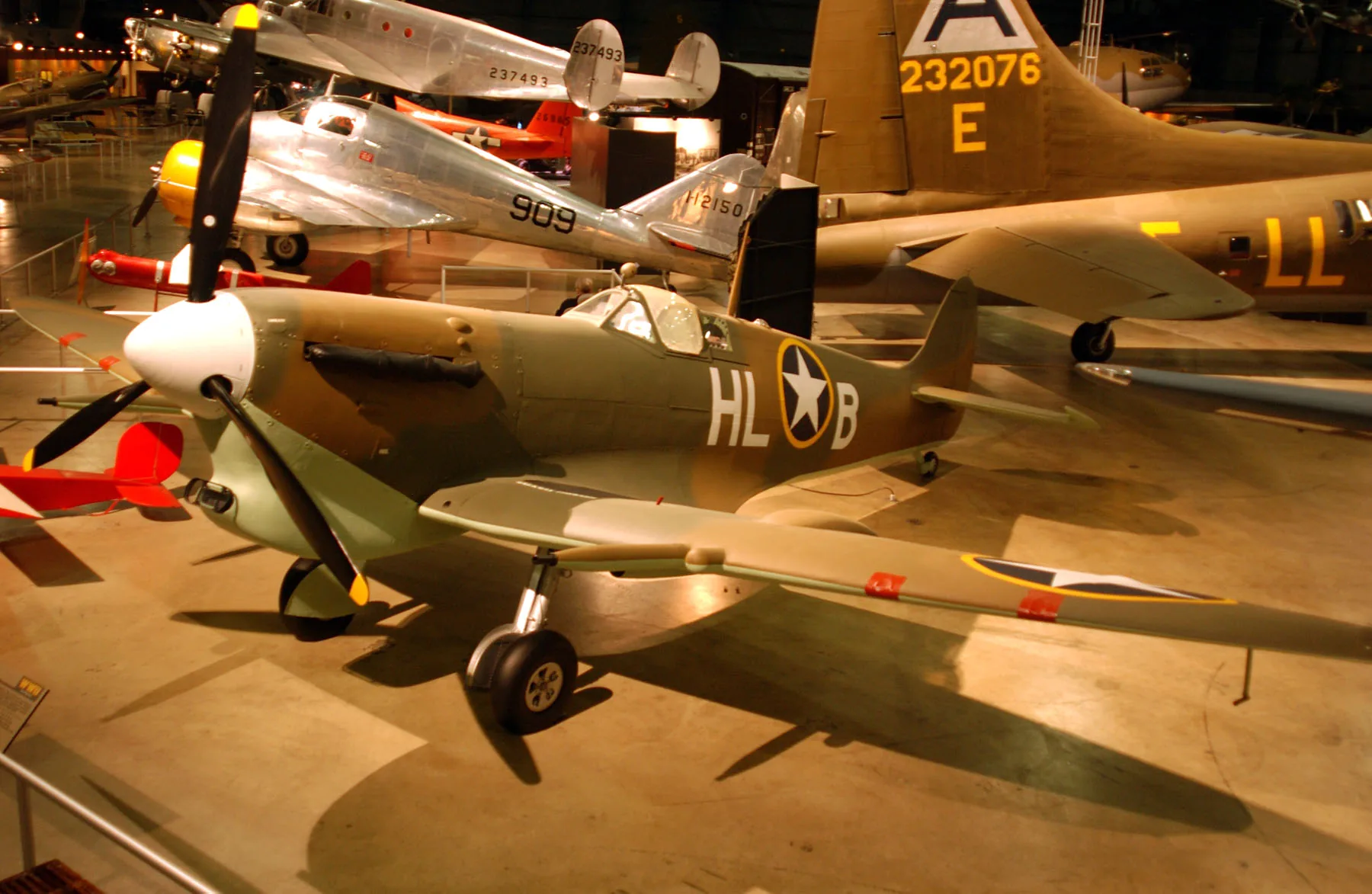
The Mk Vc displayed at the National Museum of the United States Air Force was built under license by Vickers-Armstrong in June 1943. It was shipped to Australia later that year and served with the Royal Australian Air Force. [1]
Individual aircraft: National Museum of the United States Air Force Spitfire Mk Vc
The museum acquired the aircraft from the Imperial War Museum in March 2000. [1]
Individual aircraft: National Museum of the United States Air Force Spitfire Mk Vc
This individual aircraft’s production and service history must not be generalized to every Spitfire Mk Vc. [1]
Historical Significance
Aircraft family
The Spitfire illustrates how a successful fighter design could remain operationally relevant through successive improvements rather than a single fixed configuration. [1]
Aircraft family
The Mk V series is particularly significant as a wartime response to rapidly changing combat requirements. Its engine and wing developments helped bridge the gap between early Spitfires and later, more advanced versions. [1]
Reference data
Specifications
Representative Variant Specifications
Spitfire Mk Vc
These specifications apply to the Spitfire Mk Vc variant and should not be read as values for every Spitfire version.
Dimensions
| Measurement | Value |
|---|---|
| Length | 9.12 m29 ft 11 in |
| Wingspan | 11.23 m36 ft 10 in |
| Height | 3.47 m11 ft 4.75 in |
Performance
| Measurement | Value |
|---|---|
| Maximum speed | 602 km/h374 mph |
Powerplant
piston · Spitfire Mk Vc
Rolls-Royce Merlin 45
Quantity: 1
Reference data
Variants
Recorded variants of this aircraft family. Variant entries here do not create separate public pages.
Reference data