Aircraft record
North American P-51 Mustang
P-51 · North American Aviation · United States
- Roles
- Fighter (Primary)
- Era
- World War II
Reference data
Quick facts
- Manufacturer
- North American Aviation
- Country
- United States
Reference data
Historical Content
Overview
Aircraft family
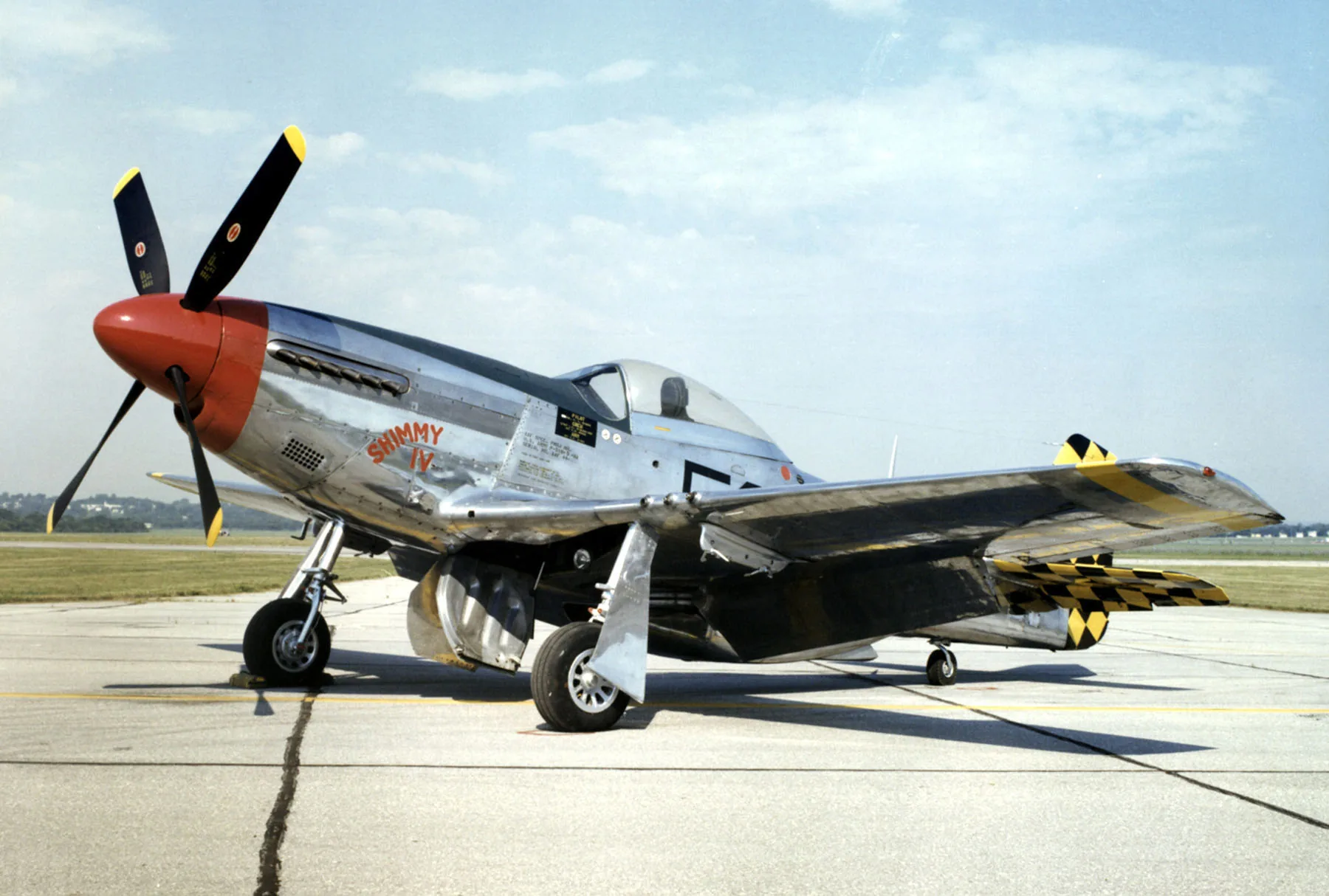
The North American P-51 Mustang was an American single-engine fighter developed during World War II. Originally designed for a British requirement, it evolved into one of the most important long-range escort fighters used by Allied air forces. Its combination of speed, operating range and maneuverability made it suitable for fighter escort, air combat and attacks against ground targets. [1][2]
Development and Origins
Aircraft family
The Mustang originated in 1940, when British purchasing representatives approached North American Aviation about producing fighters. Instead of manufacturing the Curtiss P-40 under license, North American proposed an original design. The new aircraft first flew on October 25, 1940. [2]
Aircraft family
Early Mustangs used Allison engines and demonstrated promising performance, particularly at lower and medium altitudes. Subsequent experimentation with Rolls-Royce Merlin engines led to substantially improved high-altitude performance. The Merlin-powered versions helped transform the Mustang into a long-range escort fighter capable of accompanying bombers deep into enemy territory. [2]
P-51D Design and Features
World War II Operational History
Aircraft family
The Mustang became especially important during the Allied strategic bombing campaign in Europe. Earlier escort fighters could not always accompany bombers throughout their missions, leaving formations vulnerable during portions of their routes. [2]
Aircraft family
Merlin-powered Mustangs provided the range and performance needed for long-distance escort operations. They engaged enemy fighters and also carried out attacks against airfields and ground installations. [2]
Aircraft family
Mustangs served in other theaters as well, including the Pacific, where their range was useful during long-distance operations. [2]
Legacy
Aircraft family
The Mustang remains closely associated with the development of effective long-range fighter escort during World War II. Its service continued beyond the conflict, including ground-support operations during the Korean War. [2]
Aircraft family
The family is historically significant not because every variant shared identical characteristics, but because successive developments produced a versatile aircraft that fulfilled several different wartime and postwar roles. [2]
Reference data
Specifications
Representative Variant Specifications
P-51D
These specifications apply to the P-51D variant and should not be read as values for every P-51 Mustang version.
Dimensions
| Measurement | Value |
|---|---|
| Length | 9.83 m32 ft 3 in |
| Wingspan | 11.28 m37 ft 0 in |
| Height | 4.17 m13 ft 8 in |
Performance
| Measurement | Value |
|---|---|
| Maximum speed | 703 km/h437 mph |
| Cruise speed | 443 km/h275 mph |
| Range | 1,609 km1,000 miles |
| Ceiling | 12,771.1 m41,900 ft service ceiling |
Powerplant
piston · P-51D
Packard-built Rolls-Royce Merlin V-1650
Quantity: 1
Reference data
Variants
Recorded variants of this aircraft family. Variant entries here do not create separate public pages.
Reference data
Sources
- North American P-51 Mustang163d Attack Wing, U.S. Air National GuardP-51D representative variant specifications · Overview · Aircraft family · P-51D Design and Features · Variant: P-51D
- North American P-51D MustangSmithsonian National Air and Space MuseumOverview · Aircraft family · Development and Origins · Aircraft family · P-51D Design and Features · Variant: P-51D · World War II Operational History · Aircraft family · Legacy · Aircraft family