Aircraft record
Messerschmitt Bf 109
Bf 109 · Messerschmitt · Germany
- Roles
- Fighter (Primary)
- Era
- World War II
Reference data
Quick facts
- Manufacturer
- Messerschmitt
- Country
- Germany
Reference data
Historical Content
Overview
Aircraft family
The Messerschmitt Bf 109 was one of Germany’s principal single-seat fighters during World War II. The design entered the conflict as an established combat aircraft and continued to evolve throughout the war as engines, weapons and operational requirements changed. [1]
Aircraft family
Its extensive production history included numerous variants that differed in equipment and performance. The technical measurements on this page are tied to the Smithsonian’s surviving Bf 109 G-6/R3 rather than being presented as universal figures for the entire series. [1]
Origins and Early Development
Aircraft family
The first Bf 109 prototype flew in September 1935. Early development included experimentation with different powerplants before the design became associated with Daimler-Benz liquid-cooled engines. [1]
Aircraft family
The aircraft’s designation reflects its origins at Bayerische Flugzeugwerke, abbreviated Bf. Although the company later became Messerschmitt AG, the aircraft retained the Bf 109 designation in widespread usage. [1]
Aircraft family
The Bf 109 developed into a major German fighter through the years before and during World War II. [1]
Wartime Evolution
Aircraft family
The Bf 109 appeared in several major wartime versions, with improvements intended to keep pace with advances in opposing fighter aircraft. [1]
Aircraft family
Engine development was especially important. Later variants incorporated more powerful Daimler-Benz engines, while armament and equipment changed to suit different combat tasks. [1]
Aircraft family
The Bf 109 fought in the Battle of Britain and later operated extensively over the Eastern Front and against Allied air operations in Western Europe. [1]
The Gustav Series
Variant: Bf 109 G series · Subfamily history.
The Bf 109G, commonly known as the Gustav, became the most extensively produced major version of the Bf 109 series. [1]
Variant: Bf 109 G series · Subfamily history.
G-series fighters used Daimler-Benz DB 605 engines and appeared with different weapons and equipment arrangements. Some configurations were adapted for attacks against bomber formations, while others emphasized different operating requirements. [1]
Variant: Bf 109 G series · Subfamily history.
The existence of numerous G-series configurations means that engine output, maximum speed and range must be attributed to the specific version documented by a source. [1]
The Smithsonian G-6/R3
Individual aircraft: Smithsonian Messerschmitt Bf 109 G-6/R3
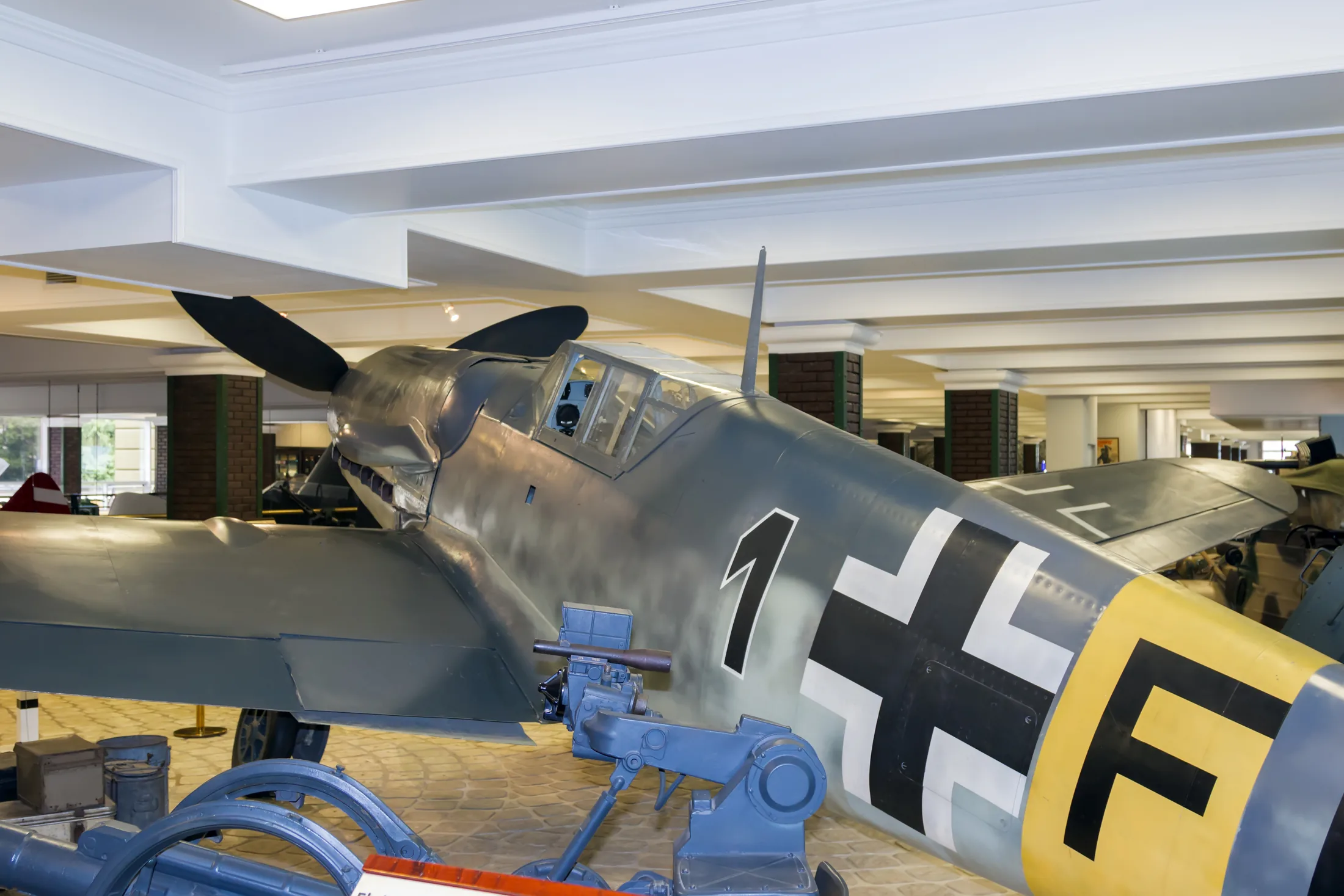
The Bf 109 G-6/R3 preserved by the Smithsonian has an unusually well-documented individual history. [1]
Individual aircraft: Smithsonian Messerschmitt Bf 109 G-6/R3
The aircraft was manufactured in 1943 and later flown by René Darbois, who landed it at an Allied-controlled airfield in Italy on July 25, 1944. [1]
Individual aircraft: Smithsonian Messerschmitt Bf 109 G-6/R3
The aircraft was subsequently transferred to the United States for evaluation and eventually entered the National Air and Space Museum collection. [1]
Individual aircraft: Smithsonian Messerschmitt Bf 109 G-6/R3
Its restored markings do not necessarily reproduce its original wartime appearance, an important distinction when interpreting museum photographs. [1]
Historical Significance
Aircraft family
The Bf 109 remained central to German fighter operations despite continual changes in aircraft technology and wartime demands. [1]
Aircraft family
Its long service history demonstrates both the adaptability of the original design and the limitations that emerged as increasingly capable opposing fighters entered combat. [1]
Aircraft family
The surviving Smithsonian aircraft provides a documented example of the Gustav series and illustrates the importance of distinguishing individual airframes from general aircraft-family history. [1]
Reference data
Specifications
Representative Variant Specifications
Bf 109 G-6/R3
These specifications apply to the Bf 109 G-6/R3 variant and should not be read as values for every Bf 109 version.
Dimensions
| Measurement | Value |
|---|---|
| Length | 9.02 m9.02 m |
| Wingspan | 9.92 m9.92 m |
| Height | 3.4 m3.4 m |
Weight
| Measurement | Value |
|---|---|
| Empty weight | 2,700 kg2,700 kg |
Reference data
Variants
Recorded variants of this aircraft family. Variant entries here do not create separate public pages.
Reference data