Aircraft record
Vought F-8 Crusader
F-8 · Vought · United States
- Roles
- Fighter (Primary)
- Era
- Cold War
Reference data
Quick facts
- Manufacturer
- Vought
- Country
- United States
Reference data
Historical Content
Overview
Aircraft family
The Vought F-8 Crusader was an American supersonic carrier-based aircraft developed during the Cold War. Originally designed as a day fighter for the United States Navy, it became well known for its variable-incidence wing and its service in naval aviation. [1]
Aircraft family
The family also included photographic reconnaissance versions. The technical dimensions on this page refer to the Smithsonian's RF-8G, a reconnaissance conversion, rather than to an unspecified F-8 fighter. [1]
Aircraft family
This distinction is important because reconnaissance variants carried different equipment and performed different operational missions from the original fighter versions. [1]
Origins and Development
Aircraft family
Development of the Crusader began in response to a 1953 United States Navy requirement for a new supersonic day fighter. [1]
Aircraft family
The prototype XF8U-1 first flew on March 25, 1955. The design subsequently became one of the Navy's important carrier-based fighter aircraft during the transition to supersonic flight. [1]
Aircraft family
The aircraft originally carried the F8U designation. In 1962, the U.S. military designation system changed, and the type became known as the F-8. [1]
Variable-Incidence Wing
Aircraft family
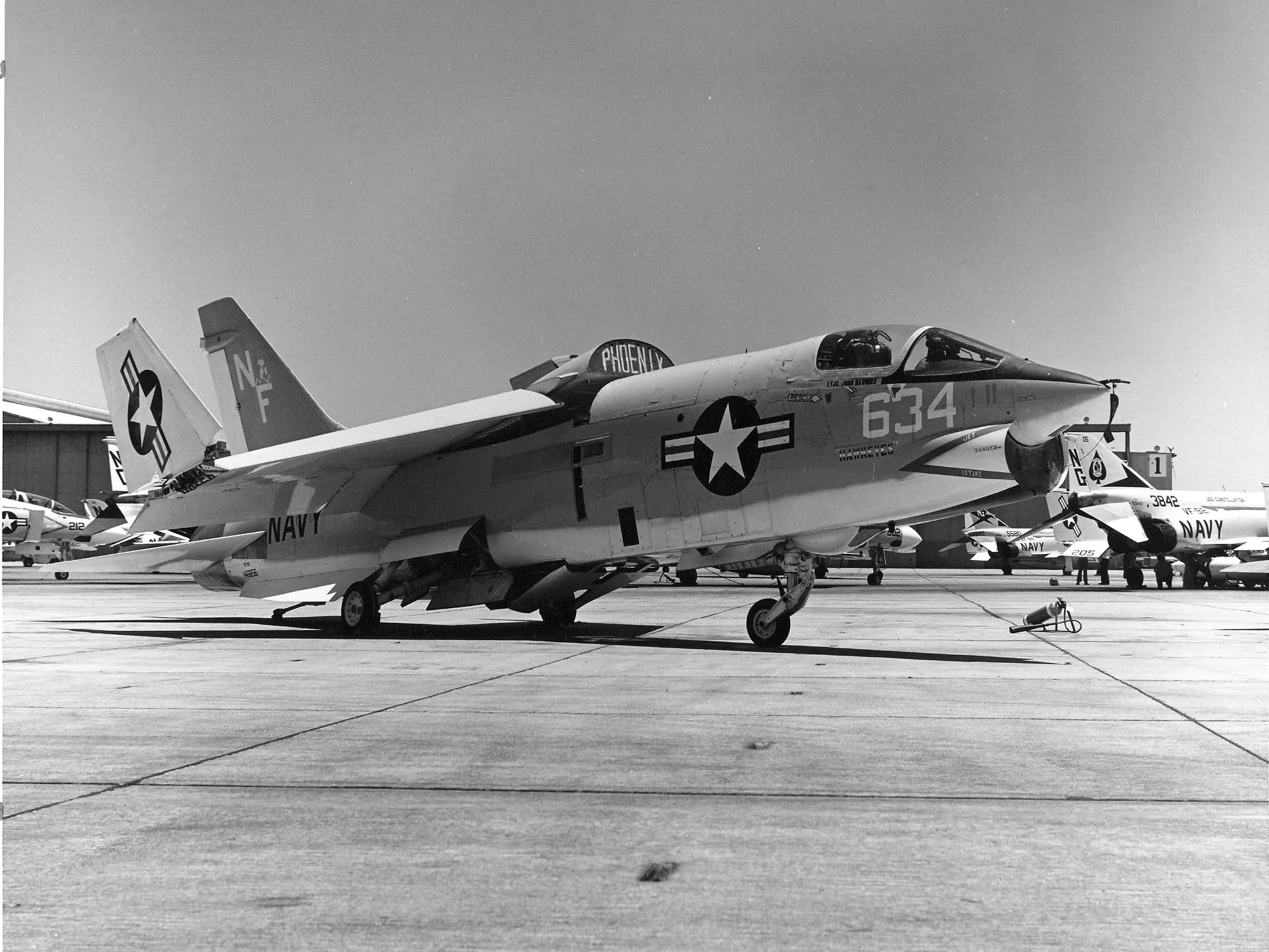
One of the Crusader's most distinctive features was its variable-incidence wing. [1]
Aircraft family
The wing could rotate about its rear attachment, raising the leading portion relative to the fuselage. This arrangement helped improve handling and visibility during takeoff and landing while allowing the fuselage to remain in a more suitable attitude for carrier operations. [1]
Aircraft family
The outer wing sections could also fold upward for storage aboard aircraft carriers. [1]
Aircraft family
These design features reflected the challenge of combining high-speed flight with the relatively low approach speeds required for carrier landings. [1]
Reconnaissance Development
Variant: RF-8G reconnaissance subfamily
Alongside fighter development, a photographic reconnaissance version was created using the Crusader airframe. [1]
Variant: RF-8G reconnaissance subfamily
The RF-8A was subsequently upgraded through a modification program that began in the 1960s. Improvements included structural reinforcement and changes to electrical, navigation and other equipment. [1]
Variant: RF-8G reconnaissance subfamily
Modified reconnaissance aircraft received the RF-8G designation. [1]
Variant: RF-8G reconnaissance subfamily
The RF-8G therefore represents a specialized reconnaissance branch of the Crusader family rather than simply another fighter weapons configuration. [1]
Operational History
Aircraft family
The Crusader served with the United States Navy and Marine Corps, including during the Vietnam War. [1]
Variant: RF-8G reconnaissance subfamily
Fighter variants carried out air-defense and combat missions, while reconnaissance versions gathered photographic information used for operational planning and assessment. [1]
Variant: RF-8G reconnaissance subfamily
The continued use of reconnaissance Crusaders after the fighter's main operational period demonstrated the adaptability of the airframe to a specialized mission. [1]
The Smithsonian RF-8G
Individual aircraft: Smithsonian RF-8G (BuNo 144618)
The RF-8G preserved at the National Air and Space Museum was originally delivered as an F8U-1P in 1959. [1]
Individual aircraft: Smithsonian RF-8G (BuNo 144618)
During its service, it operated with Marine Corps units and participated in Southeast Asia operations. It was later modified and continued flying in the photographic reconnaissance role. [1]
Individual aircraft: Smithsonian RF-8G (BuNo 144618)
The aircraft was transferred to the Smithsonian in March 1987 and is recognized as the final operational United States Navy Crusader. [1]
Individual aircraft: Smithsonian RF-8G (BuNo 144618)
Its individual service history must not be treated as representative of every F-8 built. [1]
Historical Significance
Aircraft family
The Crusader occupies an important place in the development of supersonic carrier aviation. [1]
Aircraft family
Its variable-incidence wing was a distinctive engineering response to the demands of carrier operations, while its reconnaissance derivatives showed how a fighter airframe could continue serving in a specialized role. [1]
Aircraft family
The RF-8G is particularly valuable for illustrating the differences between an aircraft family, its operational variants and the history of an individual preserved airframe. [1]
Reference data
Specifications
Representative Variant Specifications
RF-8G
These specifications apply to the RF-8G variant and should not be read as values for every F-8 Crusader version.
Dimensions
| Measurement | Value |
|---|---|
| Length | 16.61 m54 ft 6 in |
| Wingspan | 10.72 m35 ft 2 in |
| Height | 4.8 m15 ft 9 in |
Reference data
Variants
Recorded variants of this aircraft family. Variant entries here do not create separate public pages.
Reference data