Aircraft record
McDonnell Douglas F-4 Phantom II
F-4 · McDonnell · United States
- Roles
- Fighter (Primary)
- Era
- Cold War
Reference data
Quick facts
- Manufacturer
- McDonnell
- Country
- United States
Reference data
Historical Content
Overview
Aircraft family
The McDonnell Douglas F-4 Phantom II was an American twin-engine, two-seat supersonic combat aircraft developed initially for United States Navy fleet defense. It subsequently became a major multirole aircraft used by the U.S. Navy, Marine Corps and Air Force, as well as numerous international operators. [1]
Aircraft family
Although the Phantom II was originally associated with interception and air defense, it developed into a versatile aircraft capable of air-to-air combat, conventional attack and other missions. The specifications on this page describe the F-4C, the United States Air Force's first Phantom II variant, rather than every aircraft in the F-4 family. [1]
Development and Service Introduction
Aircraft family
The original Phantom II first flew in May 1958 as a naval fighter. Its design combined powerful twin engines with a two-person crew and the ability to operate at supersonic speed. [1]
Variant: F-4C
The United States Air Force later selected the Phantom II for its own requirements. The first F-4C flew in May 1963, and production deliveries began approximately six months afterward. [1]
Aircraft family
This transition from a naval fighter to a major Air Force combat aircraft was an important part of the Phantom II's development. [1]
F-4C Design and Equipment
Variant: F-4C
The F-4C used two General Electric J79-GE-15 turbojet engines. Its airframe could carry a substantial external weapons load for both air-to-air and air-to-ground operations. [1]
Variant: F-4C
The museum's displayed F-4C illustrates a 1967 combat configuration with AIM-7 Sparrow and AIM-9 Sidewinder missiles, conventional bombs, external fuel tanks and electronic countermeasures equipment. [1]
Variant: F-4C
This museum weapons arrangement is an example of one operational configuration, not a fixed loadout carried by every F-4C. [1]
Vietnam War Operations
Variant: F-4C
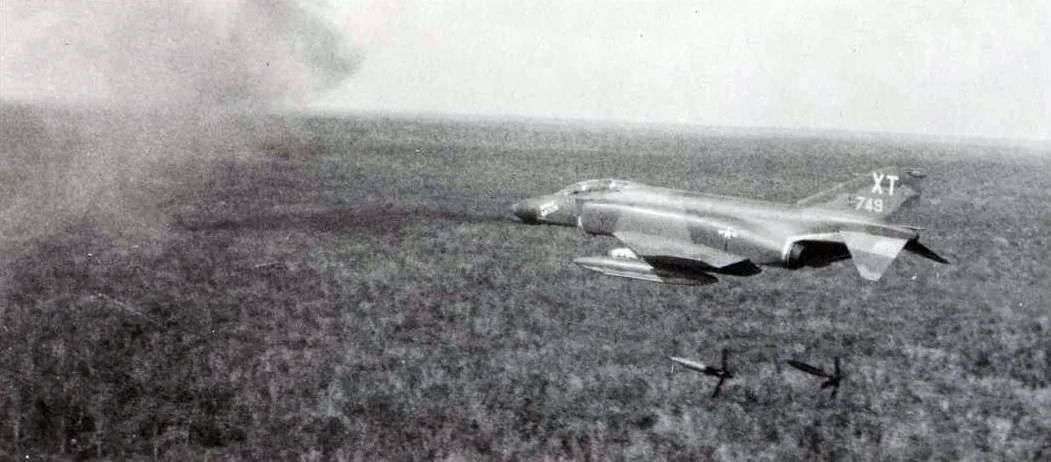
The United States Air Force sent its first F-4Cs to Southeast Asia in 1965. During the Vietnam War, the aircraft performed both fighter and ground-attack missions. [1]
Variant: F-4C
The Phantom II operated in an environment where air combat, surface-to-air missiles and ground defenses required crews to use a wide range of tactics and equipment. [1]
Variant: F-4C
Its ability to carry air-to-air missiles alongside a substantial conventional weapons load made the F-4C particularly adaptable to different combat assignments. [1]
The Museum F-4C
Individual aircraft: Displayed F-4C museum aircraft
The F-4C displayed at the National Museum of the United States Air Force is associated with Colonel Robin Olds and weapons systems officer Lieutenant Stephen Croker. [1]
Individual aircraft: Displayed F-4C museum aircraft
On May 20, 1967, the crew destroyed two MiG-17 fighters in a single day during operations over Southeast Asia. [1]
Individual aircraft: Displayed F-4C museum aircraft
That event belongs to the specific museum aircraft and crew. It must not be generalized to the operational history of every F-4C. [1]
Production and Legacy
Aircraft family
Production of the Phantom II ended in 1979 after more than 5,000 aircraft had been built. [1]
Aircraft family
The F-4 served across multiple military organizations and national air forces, reflecting the adaptability of the design to changing combat requirements. [1]
Aircraft family
Its long service history also illustrates the development of multirole tactical aircraft during the Cold War, when a single airframe increasingly needed to support both air-defense and strike missions. [1]
Reference data
Specifications
Representative Variant Specifications
F-4C
These specifications apply to the F-4C variant and should not be read as values for every F-4 Phantom II version.
Dimensions
| Measurement | Value |
|---|---|
| Length | 17.73 m58 ft 2 in |
| Wingspan | 11.71 m38 ft 5 in |
| Height | 5.03 m16 ft 6 in |
Performance
| Measurement | Value |
|---|---|
| Maximum speed | 2,253 km/h1,400 mph |
| Cruise speed | 950 km/h590 mph |
| Range | 2,816 km1,750 miles |
Powerplant
turbojet · F-4C
General Electric J79-GE-15
Quantity: 2
Reference data
Variants
Recorded variants of this aircraft family. Variant entries here do not create separate public pages.
Reference data