Aircraft record
Grumman F-14 Tomcat
F-14 · Grumman · United States
- Roles
- Fighter (Primary)
- Era
- Cold War
Reference data
Quick facts
- Manufacturer
- Grumman
- Country
- United States
Reference data
Historical Content
Overview
Aircraft family
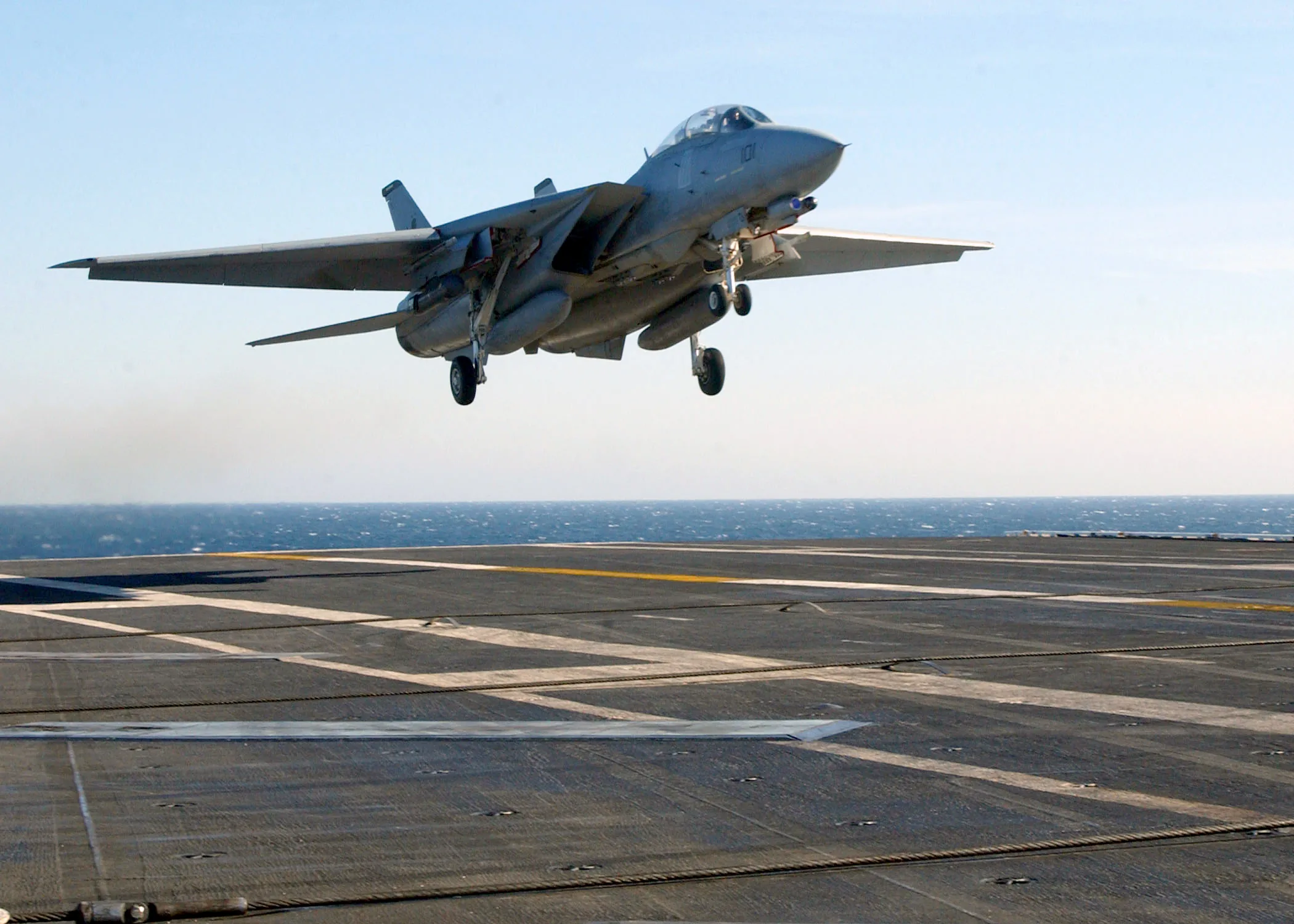
The Grumman F-14 Tomcat was an American twin-engine, two-seat, variable-sweep-wing combat aircraft developed for the United States Navy. [1][2]
Variable-Sweep Wing Design
Aircraft family
A defining feature of the F-14 was its variable-sweep wing. [1]
Aircraft family
The aircraft could change its wing sweep to suit different phases of flight and operating conditions. This provided a distinctive combination of low-speed handling requirements and high-speed aerodynamic performance. [1]
Aircraft family
The difference between wings-spread and swept configurations is especially important when discussing the Tomcat's dimensions. [1]
Aircraft family
A single wingspan figure without configuration information can therefore be misleading. This page uses the museum's wings-spread measurement for the main size comparison and preserves the swept-wing measurement separately. [1]
Fleet Defense and Air Superiority
Aircraft family
The F-14 was originally developed to protect carrier battle groups against aerial threats. [1][2]
The F-14D and Precision Strike
Variant: F-14D
The F-14D represented an advanced development of the Tomcat. [1]
Variant: F-14D
Its equipment supported a broader range of operations, including precision attacks against ground targets. The aircraft could use systems such as LANTIRN to support laser-guided weapons employment. [1]
Variant: F-14D
Certain F-14D aircraft also supported tactical reconnaissance functions through dedicated equipment. [1]
Variant: F-14D
These later capabilities must not be assumed to have existed in the same form on early F-14A aircraft. [1]
The Smithsonian F-14D(R)
Individual aircraft: Smithsonian F-14D(R), BuNo 159610
The Smithsonian's F-14D(R), Bureau Number 159610, was originally manufactured as an F-14A-85-GR. [1]
Individual aircraft: Smithsonian F-14D(R), BuNo 159610
It was among the aircraft rebuilt to F-14D(R) configuration during the early 1990s. [1]
Individual aircraft: Smithsonian F-14D(R), BuNo 159610
Before that conversion, the aircraft was associated with an air-to-air engagement off the Libyan coast on January 4, 1989, when F-14As from VF-32 engaged Libyan MiG-23 fighters. [1]
Individual aircraft: Smithsonian F-14D(R), BuNo 159610
That event belongs to the aircraft's earlier F-14A service history and must not be presented as a combat victory achieved while it was already configured as an F-14D(R). [1]
Historical Significance
Aircraft family
The F-14 Tomcat became one of the most recognizable American naval aircraft of the late Cold War. [1][2]
Reference data
Specifications
Representative Variant Specifications
F-14D(R)
These specifications apply to the F-14D(R) variant and should not be read as values for every F-14 Tomcat version.
Dimensions
| Measurement | Value |
|---|---|
| Length | 18.9 m744 1/16 in |
| Wingspan | 19 m748 in (wings spread) |
| Height | 4.8 m189 in |
Reference data
Variants
Recorded variants of this aircraft family. Variant entries here do not create separate public pages.
Reference data
Sources
- Grumman F-14D(R) TomcatSmithsonian National Air and Space MuseumF-14D(R) representative variant specifications · Overview · Aircraft family · Variable-Sweep Wing Design · Aircraft family · Fleet Defense and Air Superiority · Aircraft family · The F-14D and Precision Strike · Variant: F-14D · The Smithsonian F-14D(R) · Individual aircraft: Smithsonian F-14D(R), BuNo 159610 · Historical Significance · Aircraft family
- Grumman F-14A Tomcat Manual [Nassauer]Smithsonian National Air and Space Museum ArchivesOverview · Aircraft family · Origins and Navy Service · Aircraft family · Fleet Defense and Air Superiority · Aircraft family · Historical Significance · Aircraft family