
Aircraft record
Boeing B-17 Flying Fortress
B-17 · Boeing · United States
- Roles
- Bomber (Primary)
- Era
- World War II
- Status
- Retired
Reference data
Overview
Boeing is the primary manufacturer record; Boeing, Lockheed-Vega, and Douglas production is documented separately.
Reference data
Quick facts
- First flight
- 1935
- Manufacturer
- Boeing
- Country
- United States
- Status
- Retired
Reference data
Historical Content
Development and History
Aircraft family
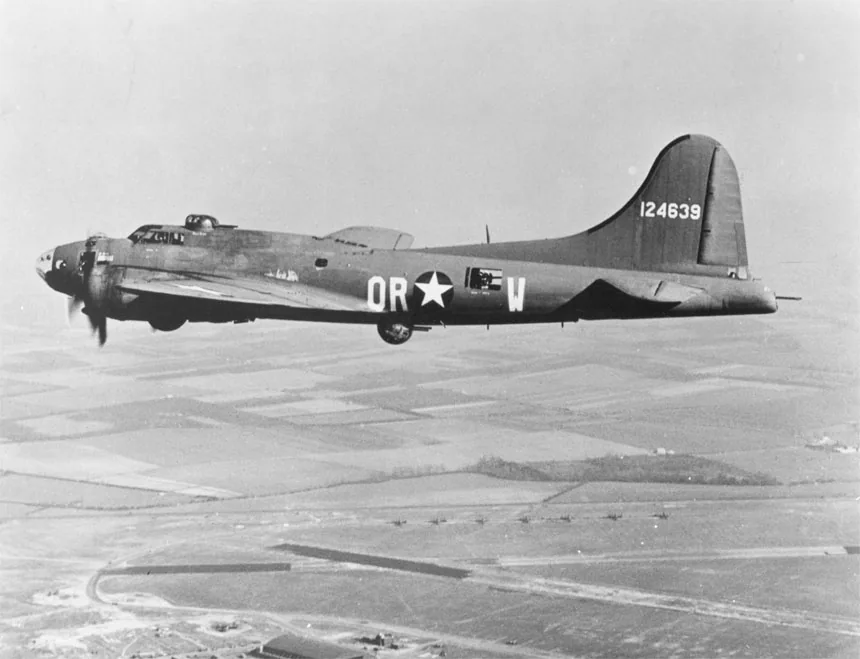
The Boeing B-17 Flying Fortress was an American four-engine heavy bomber that became one of the defining aircraft of the United States Army Air Forces during World War II. [1]
Aircraft family
The B-17 prototype first flew in 1935. Although relatively few aircraft were in service when the United States entered the war in 1941, production expanded substantially as Boeing, Lockheed-Vega and Douglas built the bomber in large numbers. [1]
Design and Features
Aircraft family
The B-17 was designed around high-altitude performance, speed and extensive defensive armament. Its turbosupercharged engines supported high-altitude bombing operations, while powered turrets and flexible gun positions helped defend against attacking aircraft. [1]
Aircraft family
These characteristics reflected the operational demands placed on American heavy bombers during World War II. [1]
Operational History
Aircraft family
The B-17 operated in every major combat zone during World War II, although its most significant service was in Europe. Alongside the Consolidated B-24 Liberator, it formed a central part of the United States Army Air Forces' strategic bombing campaign against Germany. [1]
Aircraft family
B-17 crews undertook demanding missions against heavily defended industrial and military targets. [1]
Important Variants
Variant: B-17F and B-17G
The B-17F was the principal heavy bomber version used during the early phase of the American strategic bombing campaign. The later B-17G introduced improved frontal defensive armament, including a nose turret, and became the most numerous B-17 variant. [1]
Individual aircraft: B-17F Memphis Belle · This preserved aircraft is not representative of every B-17's operational history.
The museum's B-17F Memphis Belle became famous for completing 25 combat missions over Europe before returning to the United States. It is a specific preserved aircraft and should not be treated as representative of every B-17's operational history. [1]
Reference data
Specifications
Representative Variant Specifications
B-17F
These specifications apply to the B-17F variant and should not be read as values for every B-17 Flying Fortress version.
Weight
| Measurement | Value |
|---|---|
| Empty weight | 16,205.9 kg35,728 pound |
Performance
| Measurement | Value |
|---|---|
| Maximum speed | 523 km/h325 mile per hour |
| Range | 4,506 km2,800 mile |
| Combat radius | 966 km600+ milesat least; source states 600+ miles |
| Ceiling | 11,430 m37,500 foot maximum ceiling |
Powerplant
piston · B-17F
Wright R-1820-97
Quantity: 4
Reference data
Variants
Recorded variants of this aircraft family. Variant entries here do not create separate public pages.
Reference data